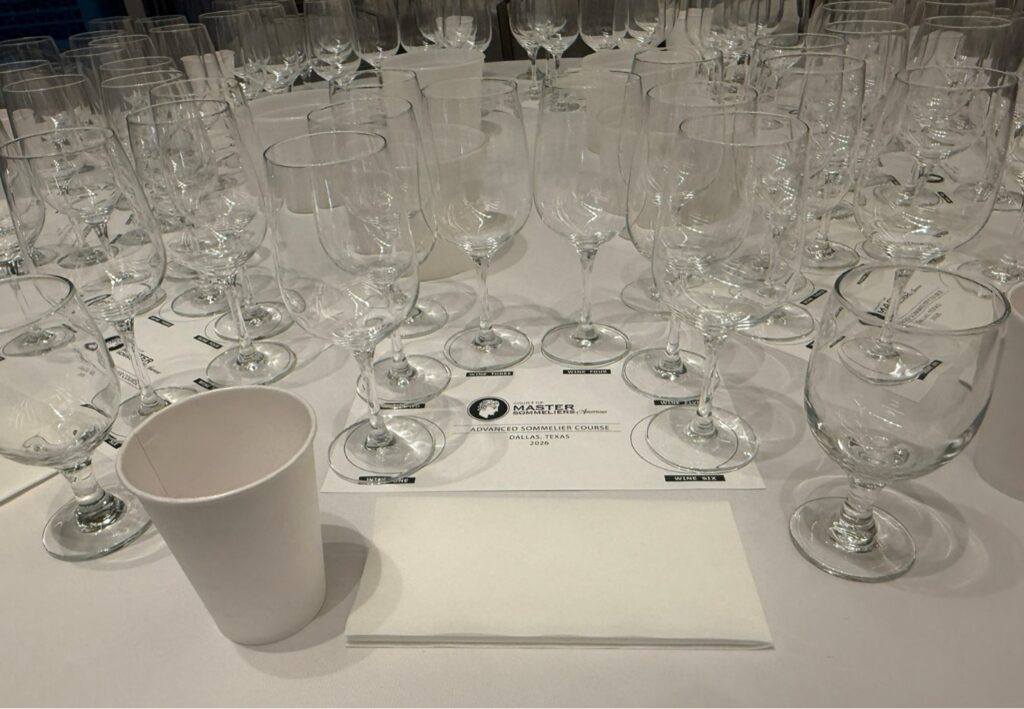
Recently, I was in Dallas for the MS Advanced Course. The class is only given once a year. This year’s edition had 188 students from five countries, with over 30 Master Sommeliers teaching and coaching. The three day program is broken down into lectures alternating with breakout tastings, where students sit with one of the MS instructors, getting one-on-one coaching as they taste through a flight of wines.
I’ve long thought the Advanced Course is one of the best wine classes of any kind on the planet. The lectures are all deep dives by MS’s who are experts on their particular subject. This year Julie Dalton and Jesse Becker gave a superb lecture on the current state of German wines. June Rodil and Brahm Callahan likewise did an outstanding job presenting on the business of the sommelier and running a beverage program.
The breakout tastings comprised themed flights of wines with students doing the heavy lifting and the MS instructors doing the coaching. Tasting themes included terpenes/floral in semi-aromatic and aromatic white wines, pyrazines in red wines, and different styles of Italian sparkling wines based on winemaking methods.
The range of tasting experience with students varied a great deal. Some had already memorized the grid and were working with a tasting group. Others had just started to learn the grid and still had to look at a printed version of it while tasting. Regardless, I matched my coaching to the individual student at their level and made sure they got the coaching they needed.
After each of my groups had finished up their assigned tastings, I offered some advice on how to prepare for the exam. I began by acknowledging that we’d crammed their heads full of information about tasting over the last few days by design. But after the fact, they would need to distill all the information down into a handful of strategies they could use to prepare for the exam. Further, they would need to simplify those strategies as much as possible.
With that, here is the advice I gave students in my tasting groups. I hope it will help those reading to prepare for the exam.
Know the grid cold
This one may seem obvious, but there’s a catch. To do well in an exam, you have to know the grid so well you could teach it. That means the grid now lives in your long term memory. So when you’re in the middle of an exam, you always know what’s next. That is precisely where you want to be.
Know cause and effect
Cause and Effect is the “why” behind the way a wine looks, smells, and tastes the way it does. Knowing Cause and Effect in detail is to understand each criteria of the grid so well you can once again teach it or explain it. After all, one of the reasons why you’re getting a wine certification is to be able to teach industry people and consumers.
Know impact compounds and be able to connect them to classic grapes and wines
Impact compounds are a subset of aromas and flavors that industry people must own to have any degree of expertise at tasting. These compounds include terpenes, pyrazines, rotundone, carbonic maceration, stem inclusion, lees contact, and more. Further, one needs to be able to connect the compounds to classic grapes/wines. For example, connecting terpenes to semi-aromatic and aromatic white grapes, pyrazines to Sauvignon Blanc and Cabernet-family red grapes, and rotundone to Grüner Veltliner and Rhône varieties. I can’t stress enough the importance of knowing impact compounds. They are one of the keystones to being a professional taster.
Be precise and consistent in assessing structure
Along with Cause and Effect and impact compounds, being good at assessing structure is a vital part of tasting exam prep. The levels of acidity, alcohol, tannin, and phenolic bitterness are an important part of a wine’s signature that reflect the grape variety, the place of origin, and the vintage. Further, connecting the dots between the fruit character/condition of a wine and its structure is important. For example, a red wine with raisinated fruit will have high alcohol, less natural acidity, and will probably be acidulated. Or a white wine with tart, underripe fruit will have high acidity and less alcohol.
Make good deductive conclusions
The conclusion is arguably the most challenging part of the entire grid. Making a good conclusion during tasting practice or an exam requires you to consider every line of the grid as you work through the wine. At the same time, you have to listen to yourself and look for important pieces of the overall pattern that when put together form the signature of a classic grape/wine.
To make the conclusion process simpler, I suggest students use the following four questions for white and red wines:
White wines
1. Does the wine have new oak?
If so, the wine is probably Chardonnay, Viognier, Sauvignon Blanc/blend, or a Marsanne/Roussanne blend.
2. Does the wine have obvious earth/mineral—or not?
If earth and mineral are a dominant feature of the wine, odds are it’s from a European region. If not, it’s from a New World country. There are exceptions like Clare Valley or Eden Valley Riesling.
3. Does the wine have impact compounds that can help me identify it?
Here is where knowing impact compounds and connecting them to classic grapes and wines is important. Linking terpenes to wines such as Albariño, Torrontes, and others. Also knowing that if a wine is floral, it will have phenolic bitterness.
4. Is there anything about the wine’s structure I should note?
When making a conclusion, noting if anything about the structure of a wine is “high.” Like the high acidity in Albariño or the high alcohol of a Central Coast Viognier.
Red wines
1. Was the wine made from a thinner or thicker-skinned grape?
In blind tasting red wines, sometimes the color can quickly build expectations for what you will smell and taste. For example, a lighter-colored red wine from a thinner-skinned grape like Pinot Noir will probably be made from cooler climate fruit, be red fruit dominant, and have lots of savory notes (non-fruit), elevated acidity, moderate alcohol, and moderate tannins. As opposed to a deeply-colored red wine from Cabernet Sauvignon made from warm climate fruit that’s dark-fruit dominant with higher alcohol, less natural acidity, and higher tannins.
2. Does the wine have obvious earth and mineral—or not?
Pronounced earth/mineral in a red wine will usually—but not always—place it in Europe. A lack of earth points to a non-European region.
3. Does the wine have impact compounds that can help me identify it?
Here noting impact compounds such as pyrazines or rotundone, and connecting them to the appropriate grape/wine.
4. Is there anything about the wine’s structure I should note?
Again, noting anything on the low or high end as far as structure. The soft tannins of a Beaujolais-Villages that also has carbonic maceration and stem inclusion. Or Barolo, that often has a lighter color but high alcohol, high acidity, and high tannin.
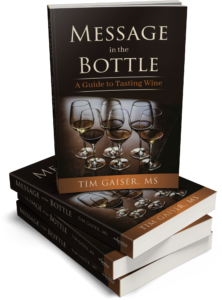
Two final bits of advice: First, narrowing down your exam strategies to five or less will keep things simple and also help to maintain your sanity. Second, using the previous questions will help to streamline your conclusion process. Finally, I strongly recommend picking up a copy of my book Message in the Bottle: A Guide to Tasting Wine. In it you’ll find detailed information about all the concepts in this post and much more.
Cheers
Learn everything you need to about wine.
Get the complete guide to tasting wine.