How do we internally process the wine experience?
In a recent post I detailed the first part of my wine presentation at the Texsom conference in August called “An approach to tasting.” The first post was about six skills I thought students needed to learn and industry pros needed to use on the regular. The skills included expertise with a tasting grid, Cause and Effect, Impact Compounds, working with what I call the “Evil Dwarfs,” assessing structure, and pattern recognition.
Part two of my presentation was titled “How we internally process the wine experience.” I began by saying the strategies I would talk about were based on the following assumptions:
- We all share the same kind of brain and nervous system.
- We process the world using our five senses: sight, hearing, feeling, smelling, and tasting.
- How we think is based on inner extensions of those five senses—especially sight, hearing, and feeling.
- Sight is the dominant internal sense.
- Over 90% of the human race thinks primarily in pictures and movies.
- Most of our memories are visually-based.
I then explained working with Tim Halbom in 2009 on his project called “Everyday Genius.” Tim is a behavioral psychologist who specializes in eye movements and language patterns. During our two sessions in front of a film crew, Tim and I deconstructed my internal sequence for smelling and tasting wine. To do so, Tim tracked my eye movements and had me stop many times to find out what I was doing internally. The results were surprising and changed my strategies for smelling and tasting wine, as well as how I taught others to do it. Here are the major take aways from the two sessions:
- I use consistent eye positions and patterns when I smell and taste wine.
- I represent smell and taste memories with internal images.
- These images have structural qualities such as size, dimension, and brightness, called submodalities.
- I have an internal map or grid to consistently arrange all the images.
- I use an internal visual cue to calibrate structural elements.
Strategy I: Using eye accessing cues for smelling and tasting
I began by saying that all experienced tasters use consistent eye patterns when smelling and tasting wine, whether they were aware of it or not. These eye positions and patterns seem to be connected to brain function and related to sensory memory and recognition.
I also stressed that this wasn’t just a “Tim Gaiser theory.” Over the course of 25 years, I’ve sat across the table from hundreds of students taking the Advanced and MS tasting exams. The students who used consistent eye patterns tended to be the ones who did the best in the exams.
Eye patterns are based on what’s called eye accessing cues, or vertical and lateral eye movements. In the 1970’s, John Grinder and colleagues at U.C. Santa Cruz observed eye patterns in relation to different kinds of sensory memory during a linguistics study. Since then, scientists have confirmed that lateral and vertical eye movements can be associated with the activation of different parts of the brain. Also, that these eye movements provide insight into how people access internally stored information.
In their work, Grinder and colleagues observed that test subjects used consistent eye movements and patterns when answering specific categories of questions. For example, most people looked up and to the left when asked questions that involved visual memories. Questions requiring visual imagination caused most subjects to look up and to the right. Other questions evoking auditory memories elicited lateral eye movements to the left, while those concerning auditory imagination resulted in lateral eye movements to the right. Queries that required internal dialogue made subjects look down and to the left. Finally, questions about anything kinesthetic (pertaining to physical or emotional sensations) resulted in eye movements down and to the right.
It’s important to note that not everyone demonstrated the same eye patterns. In some subjects, particularly those who were left handed, the movements were reversed. Regardless, everyone was found to use eye patterns on a consistent basis to access various memory functions.
I had never heard of eye accessing cues before the video sessions with Tim Halbom. With his coaching, we established my personal strategy for eye positions and smelling wine. It goes as follows:
- When I pick up the glass to smell a wine, I initially look down at a 45° angle and slightly to the left.
- My eyes are slightly unfocused and looking about 15 inches away.
- I internally ask some form of the question, “What’s there?” Or, “What am I smelling?”
- My eyes quickly move out front, looking at the space about 6-8 feet away
- Internal images of the aromas I’m getting in the wine appear in that space out in front.
- I repeat the cycle until I can’t find anything new. At which point I taste the wine.
Back to the seminar. I had the group split up into pairs to find their starting eye position. I reminded everyone that there was no “right way” to do this. Everyone’s eye positions are unique. Also, that their eyes would only be in the starting position for an instant before moving to other locations to access memories. Here were my instructions to the group:
Finding your starting eye position
- Pick up a glass with wine and start smelling it.
- While smelling the wine, focus your eyes down straight ahead in front of you at a 40-45° angle above the floor.
- Use a soft focus with your eyes.
- While continuing to smell the wine, take your free hand and point to the location where your eyes are looking.
- Now slowly move your eyes and free hand together, going from center to the left. Then move your eyes and hand back to the center and to the right, all the while continuing to smell the wine.
- Find the one place that feels the most comfortable and familiar. It shouldn’t take long to locate it.
- Once you find your “best” or starting place, be sure to mark it clearly in your memory.
- If you’re still not certain, try doing it as “wrong” as possible. Look up or to the sides while smelling the wine. Note your inner response.
- This is your starting eye position. Be sure to use it as often as you can.
I gave the group some time to take turns doing the exercise. Afterwards, I checked in and practically everyone was able to quickly find their starting eye position. Most agreed that they already used one, but weren’t aware of it.
Next, I had the group find their “processing” eye position—the place their eyes immediately move to after the starting position, and in response to their asking some form of the question, “What am I smelling?”
My instructions for finding this second eye position were as follows:
- Pick up the glass of wine and start smelling it using your starting eye position.
- Ask yourself what you are smelling, what’s in the glass, etc.
- Pay attention to where your eyes go in response to asking the question.
- Repeat the sequence several times to confirm what you do.
Strategy II: using a visual cue for calibrating structure
One of the other important strategies Tim Hallbom and I discovered, was how I use a visual cue to calibrate structural elements. Specifically, how I use an internal image of a scale that matched the levels of acid, alcohol, and tannin I’m getting in a wine. Using Google, my scale looks something like this.
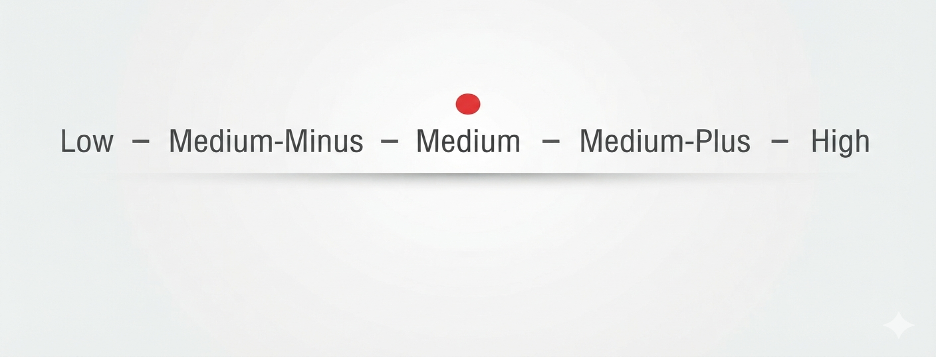
I use the scale as follows: When I assess a wine for acidity, I retaste it and hold the wine in my mouth for at least five seconds before spitting it out. I need the wine on my palate that long because, for me, structure involves delayed response.
Once I spit the wine out, I’m looking internally at my scale, which again looks like the previous image. The red button is directly on top of medium and starts to move in response to the level of acidity I’m getting in the wine. The button moves until stopping on the appropriate marker. Then I internally point to the marker and say, “It’s medium-plus acid”—or whatever the level happens to be. If I’m not quite sure about the accuracy, I can bring the scale in, with smaller increments appearing as it gets closer.
I told the group that if they were good at assessing structure, odds are that they already had something internally they used, but weren’t aware of it. If they didn’t, they could use my scale as a point of departure.
Then I showed three pairs of hypothetical wines on the PowerPoint slides along with the scale to give everyone practice at calibrating structure using the extremes of high and low:
Acidity: Clare Valley Riesling vs. Alsace Gewurztraminer
Alcohol: Vintage Port vs. Moscato di Asti
Tannin: Barolo vs. Beaujolais-Villages
As I mentioned each wine, I had the group imagine the red button moving to the appropriate place on the scale. I also suggested the group could use a similar scale to calibrate other aspects of a wine such as the intensity of aroma and flavor, the length of the finish, and the complexity.
From there, I suggested to the group that they install some kind of internal scale to help calibrate structure. I reiterated there was no one right way of doing it, but to find whatever kind of scale or dial worked best. Also, once they had a scale that seemed easy to use, to calibrate it using extremes like we’d just done.
Afterwards, there were several questions, most having to do with where everyone could find more information about the skills and strategies. I pointed them to my book, Message in the Bottle as well as my blog. Otherwise, I closed the session by reminding the group of how tasting was a combination of learned skills, sensory memory, and internal strategies that allow us to translate what’s in the glass.
Learn everything you need to about wine.
Get the complete guide from Tim Gaiser MS.