The effects of change in European wine law
Sadly, there are no Trader Joe’s or Whole Foods stores here in Rio Rancho, city of impaired vision. If you want either, you have to cross the Rio Grande (river) to the East Side, technically Albuquerque, using one of several bridges. And you wouldn’t think it, but these bridges put the Albuquerque metroplex squarely in the same category as San Francisco and Seattle. Namely a city with a body of water that can only be crossed in only so many ways using a bridge. Which means commute times create demonic traffic with an accident bringing everything to a halt.
So if I find myself on the other side of the river for any reason, a stop at either or both stores is tacked on to the trip. Which is how I found myself in Trader Joe’s the other day after running several errands. Picking up the usual tuna in olive oil in the green cans (best ever for the money), extra-crispy potato chips, and frozen mac and cheese (my son Patrick’s favorite).
I usually pick up a few bottles of vino for everyday drinking while I’m perusing the aisles. Lately, it seems as if TJ’s is trying to compete with Costco’s Kirkland wines by having their own brand. Case in point the 2024 TJ’s Bandol Rosé, which retails for juts $13.99 a bottle. Shocking, in a word, and surprisingly good. We’ve easily gone through a case of it since it appeared on the shelf sometime in the late spring/early summer.
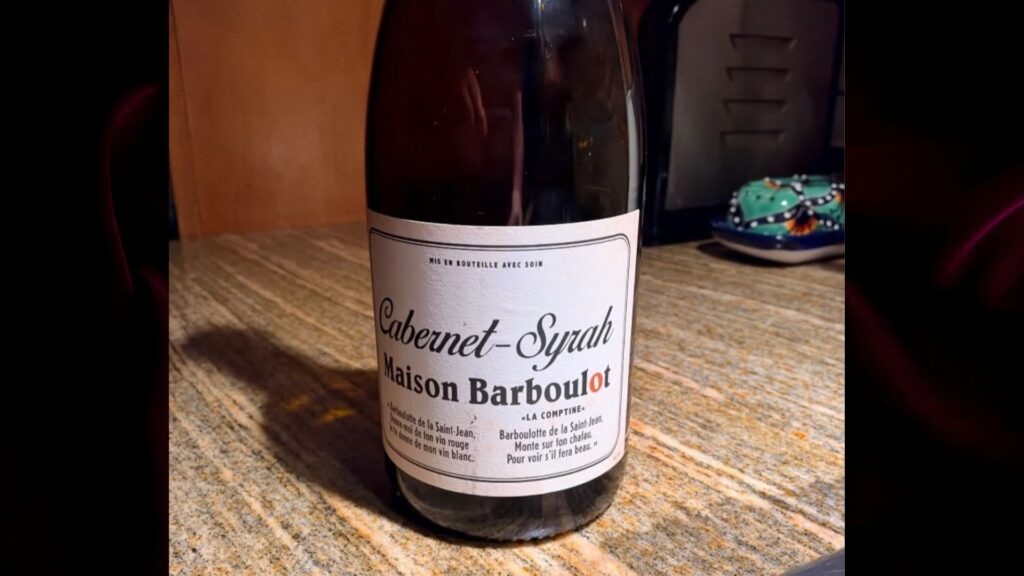
During my latest TJ soirée, I spotted a new label called Maison Barboulot. The two wines, Chardonnay-Viognier and Cabernet-Syrah, were both from Pays d’Oc IGP in Southwestern France, and priced at just $6.99. I picked up a bottle of each just to check them out.
The other night I opened the 2024 Cab-Syrah to have with our spaghetti dinner. First sip and the wine was good: ripe fruit with hints of raisination, a lack of secondary notes, and considerable new oak. But the texture of the wine made me pause. It was, for lack of a better word, smooth—the most common descriptor for the favorite style of red wine by American consumers.
My internal wine processor immediately went into overdrive. Here was an uber-ripe red wine with slightly raisinated fruit, new oak notes, and smooth tannins all for just $6.99 a bottle. That had me immediately picking up the bottle to look at the back label. First thing I noticed was the ABV was just 13.5%. Which means the wine had been put through a cross-flow filter or similar to remove some of the alcohol—which is common practice. You don’t get raisinated fruit without the potential alcohol reaching upwards of 15%. Then there was the oak, which became more prevalent the longer the wine was open. Oak is expensive, and that much oak influence in a wine costing less than $10 can only be from oak chips Finally, the smooth texture of the wine left me wondering if powdered tannins had been added to the wine at some point (or several) during or after fermentation. And given the ripeness level, had wine had been acidulated? The answer to all the previous turned out to be yes. More on that momentarily.
Otherwise, the wine really didn’t have much in the way of varietal markers as far as Cabernet or Syrah go. No pyrazines or firm tannins from Cabernet and no rotundone/pepper or savory notes from Syrah. So the wine was definitely not from the Cabernet-Shiraz universe, which is one of the true gems of Australian wine. Instead, the sum total was a bottle of pleasant but amorphous red wine. Don’t get me wrong. For $7 a bottle, I wasn’t expecting it to change my life.
Still the Barboulot checked a lot of boxes in the wine value department. Frankly, it should have—and here’s why. And now I’ll circle back to the quartet of winemaking methods mentioned above. To address that, I have to talk about teaching MS Introductory Courses back in 2011. At the time, we had to update the class PowerPoint to list the major changes to French wine law. Actually, the changes were to EU wine law as they applied to all member countries. Specifically, that under EU law there were universally protected place names and regional names. It seems as if the team in Brussels looked at the French AOC laws and decided to use them as the model. Which wouldn’t be easy given the systems of laws in countries like Germany, Austria, and Italy.
Regardless, the intent was clear. Appellation and regional names needed international protection backed up by the European Union Court, and not some legal entity in a region or country. So if some random winery in Austria started making sparkling wine and calling it Prosecco—which actually happened—the consorzio in Prosecco could sue the guilty party and take them to court in Brussels, where they would surely win.
Some of the other changes to EU laws were wineries being allowed to use oak chips for regional wines (like the Pays d’Oc), to use various means to remove alcohol from a wine, adding powdered tannin to a red wine fermentation, and to acidulate wine as needed. Mind you all the previous was verboten before the laws were changed. Or at least they required permission.
At the time, I remember thinking that the French were feeling the heat from Australian supermarket wines, with their ethos of blending from multiple sources, use of oak chips, cross-flow filtration, powdered tannins, and acidulation. The 2009 laws evened the playing field then at certain price points.
In the end, all the previous means one thing. The 2024 Maison Barboulot Cabernet-Syrah is a decent glass of wine and there are reasons for it. While shoppers at Trader Joe’s may pick up a bottle or two to enjoy with their roast beast dinner, they are the benefactors of changes in wine law. Changes that for once added flexibility to a system and didn’t restrict it. What a concept. Otherwise, the Barboulot was tasty with our spaghetti that night. Somehow, it reminded me of smooth jazz. Kenny G. in a bottle?