Is there such a thing as having a bad palate? I was asked that not long ago in a podcast interview with Sean Trace on his show Barrels and Roots. I answered Sean by saying that unless someone has anosmia—meaning they can’t physiologically smell, or ageusia when they can’t taste anything, everyone has a palate. To what extent it’s actually good for wine is another thing.
What does having a good palate for wine mean? To me, it’s someone who’s proficient at smelling, tasting, and describing wine. Theoretically, they should also be good at identifying wines in a blind tasting. But that doesn’t mean they can nail any of over 100,000 wines annually produced on a global basis. Some people out there seem to have that idea—which is somewhere between ludicrous and stupid. There are plenty of brilliant tasters who don’t blind taste. But what they can all do is judge wine quality. I think judging wine quality is the single most important attribute a professional taster must have.
Back to Sean’s question about people who are convinced that they have a bad palate. Some thoughts about that. First, wine tasting is a misnomer. It should be wine smelling because the sense of smell accounts for over 85% of the sense of taste. Second, despite what someone who thinks they have a bad palate may believe, they have smell memories. At the least, things like a dog park in August, sewer gas, and a basket full of dirty laundry. On a more pleasant side, baking bread, freshly ground coffee, or garlic sautéing in olive oil.
Everyone has smell and taste memories, unless again there’s a medical condition involved. But as far as wine goes, the issue is if someone can connect those memories to what’s in the glass. Wine then is a unique context when it comes to smell and taste. The challenge is that wine smells like things other than wine because it’s fermented. If you were to smell a certain red wine, you might find aromas like black cherries, herbs, and vanilla from oak. If you were to analyze the wine, you’d find chemical compounds similar to those in black cherries, herbs, and oak. By the way, if you feel like doing a deep dive on the chemistry of wine aromas, check out the brilliant book called Nose Dive, by Harold McGee.
Even though wine smells and tastes like things, it doesn’t mean anyone who’s interested can just pick up a glass of wine and pick out different aromas. There are connections that have to be made. Here is where training comes in. Also, where the comparison of wine to music is actually valid.
To be any good at music, you have to go through some training. Sure you can strum away on your guitar, maybe even learn to play Stairway to Heaven—which now makes you capable of annoying everyone. But to get any good at the guitar, you need to take lessons. Ditto that for any other instrument as well as singing. Even if you’re singing Stairway to Heaven, somebody needs to show you how to breathe properly. Otherwise, you’ll never be able to sustain a note. Not sure about imitating Robert Plant’s screaming in the last verse. You may want to take a pass on that.
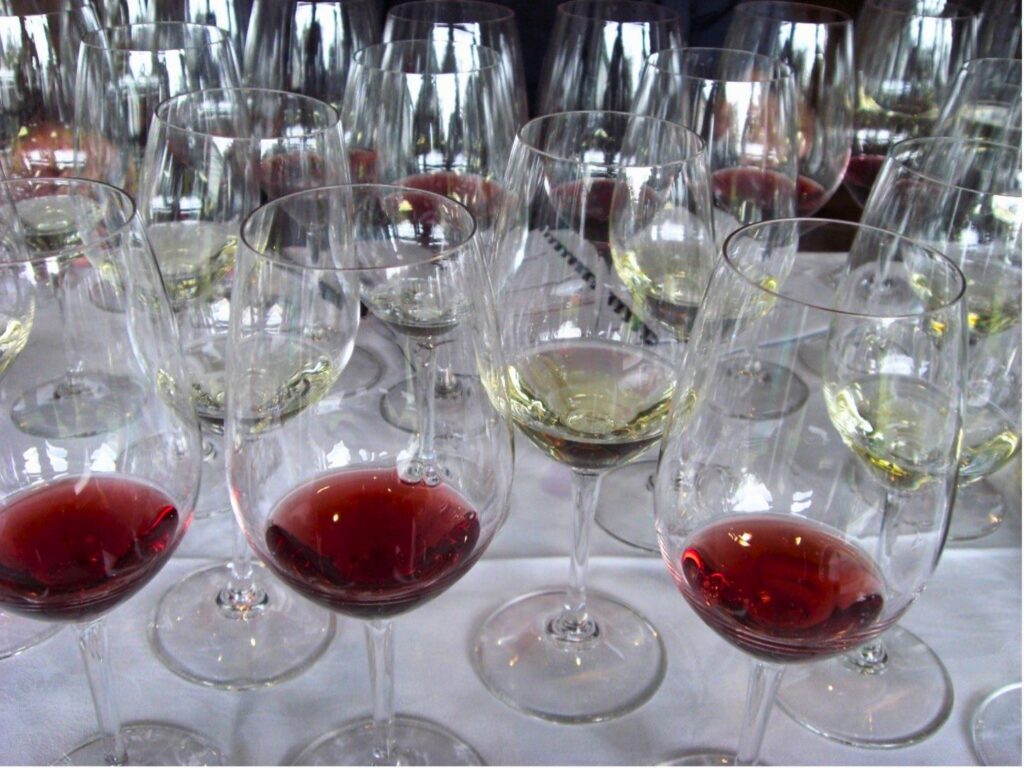
Training in wine is also mandatory, if you want to be any good at it. There are several organizations that have excellent curriculums. If you’re in the restaurant industry, the Court of Master Sommeliers (CMSA) is for you. If not, the Wines and Spirits Education Trust (WSET) has excellent classes. Both teach the basics about wines and spirits: what they’re made from, how they’re made, and where they’re made. Equally important (if not more so), these organizations have systems to teach you how to taste like a professional. Specifically, they use tasting grids that require you to look at, smell, and taste wine in a specific way. In doing so, you can not only become proficient at tasting, you’ll also be consistent at it. And it’s the consistency combined with enough experience that ultimately enables you to judge wine quality. Again, the ultimate goal of any wine certification and training.
Aside from diving into formal training, is there something a person can do that will improve their palate in the near term? The answer is yes, and it has to do with Pareto’s Law—the 80/20 rule. Some background. Vilfredo Pareto was an Italian economist. In 1895 he published a paper about his findings concerning wealth and land ownership in Italy at the time. In short, he found that 80% of the land and wealth was controlled by 20% of the people. That 80/20 ratio would go on to be true for any number of things, including the amount of peas produced by pea plants in Pareto’s garden.
Pareto’s 80/20 ratio was also called The Law of the Vital Few. When applied to wine, it means that there are about two dozen aromas and flavors found in about 80% of all wines. Things like lemon, green apple, vanilla, mushroom, and more. I call this group the Basic Set.
How does the Basic Set apply to learning to taste? If you work on your memories of these aromas/flavors on a regular basis, your ability to recognize them in a glass of wine will increase significantly. The beauty of it is that going through the list using your memories only takes several minutes a day—and doesn’t require wine. It’s also fun to do.
In the end, perhaps there are no bad palates, only inexperienced and untrained tasters. If you think you have a bad palate, sign up for a class or form a tasting group. Practice tasting. And yes, you can drink the wine too. But you learn much more when you taste. Which means you have to spit. It’s called catch and release.
Want a crash course in how to taste wine?
Join my Advanced Review Team and get a free copy of my upcoming wine book, full of answers to all the wine questions you felt too embarrassed to ask. CLICK HERE