It’s a question I sometimes get asked at consumer tastings. Someone tells me about a wine they had while on vacation in an exotic location like Provence. How it was the best thing ever. So good that they bought a case and then schlepped it back with great expense. Only to open a bottle at home and find the wine not nearly as good as when they drank it in situ. So they ask me, “Why, Santy Claus, why?” (obscure Dr. Seuss reference).
In response, I explain what I call the “beautiful sadness of life” syndrome (BSOL). When you’re on vacation in some scenic locale with your partner or friends, and you’re not worried about work/kids/life so much. Your hard drive is uncluttered and you can more easily focus on the here and now, which happens to be in a beautiful place. Then you feel moved, as they say in Pentecostal churches, especially if you’re sipping wine made in the next village over and nibbling on local delicacies.
After a glass or two, the moment takes on special meaning that you’ll remember long after the fact. As for the wine, it’s showing its best in the moment because you are in optimal sensory reception mode. Once back home, the day-to-day comes careening back, leaving little disc space for the fabulous feelings from vacation. Which is why we take vacations.
What does is all mean? That context matters in wine. So much so that if we change the context of any wine experience, how we perceive the wine also changes. Context ranges from the place where you taste a wine, the time of day, the company you’re keeping at the moment, the occasion, the glassware, and even the temperature of the wine. Context is also about you. Where you are at a particular moment in the space-time continuum. Are you having a good day? Bad day? Are you happy/cranky/sad/bored? Do you feel good/lousy/meh/inspired?
All the previous will impact how you respond to a wine. Add a special occasion, the right company, or a gorgeous setting like Provence, and you have the potential for magic. Magic that, by its nature, can’t be repeated, especially when you get back home with all its inherent baggage.
I’ve been on many wine trips over the years, so I have more experience with the BSOL syndrome than most. For example, I have a vivid memory of sitting at dinner with Manfred Prüm of famed J.J. Prüm, at his house in Wehlen in the Mosel. Looking out the large picture window at long river ships laden with coal and other goods slowly cruising up and down the Mosel. Beyond the river, the huge expanse of the Wehlener Sonnenuhr vineyard, one of Germany’s Grands Crus—and the oldest vineyard on planet earth.
Throughout the meal, Manfred makes periodic trips down into the cellar, eventually returning with bottles of his Riesling. As the evening gets on, the trips take longer and the wines get older, some bottles dating back to the 1950s. He pours each wine for my group blind and then asks us to guess the vintage. We’re consistently off by 15-20 years. Such is the magic of how slowly wine ages if you put it in a cold cellar and never move it. Otherwise, Mosel Riesling has never tasted so pure, complex, and delicious as that night at Manfred’s table.
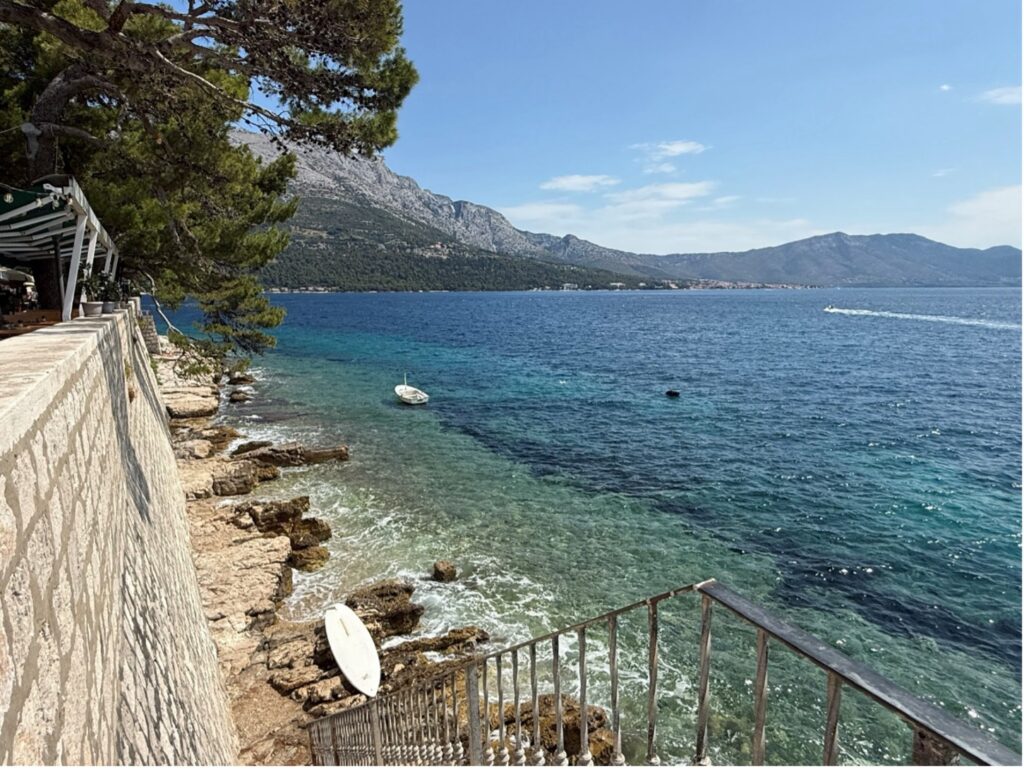
Recently, I was on a cruise from Venice to Athens. Most of the stops were in Croatia, as the trip was billed a Croatian wine cruise. Per that, good friend and colleague Paul Wagner and I took our group through two tastings of Croatian wines and also paired them with two dinners.
The wines were surprisingly good. The combination of technology and good winemaking have yielded the expected results. The country also has brilliant indigenous grapes to work with. In particular, Pošip, Malvaisa Istria, and Graševina for white grapes, and Plavac Mali, Crljenak Kaštelanski, and Teran for red. Two of the latter three are from the Zinfandel tribe.
Other than the gorgeous Dalmatian coast and stops in some truly beautiful ports, the main theme of the trip was heat management. It was incredibly hot the entire trip, meaning visits on shore in various locales were limited to just a few hours. Long enough to see the most important churches, museums, and fortresses before having to repair to a café for a cold refreshing beverage. Or head back to the ship for said cold refreshing beverage.
Some of the best wines of the trip were a trio of German Rieslings I brought from my cellar: 2002 Rheinhold Haart Piesporter Goldtröpchen Spätlese, 2002 F. Weins Prüm Erdener Prälat Spätlese, and 2001 von Buhl Forster Ungeheurer Auslese Goldkapsul. The bottles had been sleeping in storage for eons. Sharing them with Paul, his wife Margaret, and others in my immediate tribe at dinners registered high on the BSOL scale. It was also a reminder of why we cellar wine—to share it.
In the end, context rules when it comes to the wine experience. That’s why you should pay attention should you find yourself sipping Champagne watching fireworks at the Eiffel Tower. Because if you’re sipping Champagne watching fireworks at the Eiffel Tower and you’re not happy, it’s on you.
Learn everything you need to about wine.
Get the complete guide from Tim Gaiser MS.