
Every New Year’s one of the things Carla and I talk about is how we need to cook more new things. So we agree to make at least one new recipe a week, alternating who’s driving the stove. But like most New Year’s resolutions, the trend usually doesn’t make it to February before we’re back in the groove/rut with the same 6-10 things we’ve made for dinner forever.
However, for whatever reason, last year was different. I began to spend time on the Times site, looking at recipes and printing them. Before long, I’d fashioned a collection of sorts called Timmy’s Cookbook. It features a genuine hand drawing by your humble author on the cover with a stick figure at the stove panicking because something just blew up. Que dramatic.
The new recipe trend was grand. Instead of heading to the store and then seeing “what looks good,” premeditation ruled the day, with perusing multiple new recipes before heading out. After all, a crime of any stature requires careful planning. Ditto that a good meal. At least violence is not involved in the latter, unless it’s self-inflicted on the cook. That’s another matter. Regardless, soon enough a cadre of new recipes had made it into what we call the “rotation.” Meaning the results were delicious and easy enough to make that they were worth repeating. Mind you delicious and easy are not always mutually inclusive when it comes to cooking.
I’ve been working off recipes for eons. There were a few dinners we threw at our spacious three-bedroom apartment in Ann Arbor during grad school decades ago. The place had a basement that came in handy, not only for storing the earthly belongings of friends during the summer break, but also for periodic tornado warnings. Those usually happened in the afternoon or at night. At which point, we’d head down into the basement with a bottle of wine and a deck of cards or a board game. Scrabble was our go-to.
Cooking at home became more of a fixture after we moved to the City in the fall of ’84. Then, both of us worked in restaurants for the first eight years, the first five-plus years as bartenders. That meant late work nights sometimes followed by later carousing. Either way, we usually home got after midnight and drank a bottle of wine while watching old black and white sitcoms on Nick at Nite and talking about our respective shifts. That followed by sleeping late. Ah, the days of wine, roses, and no kids.
On the rare nights we had off together, Carla and I would pick some hotspot to have dinner. If not, we’d stay home and cook up a storm, as my Mom used to say. Then I’d choose something out of a recent issue of Gourmet Magazine.
I’d been reading Gourmet since the UNM undergrad orchestra days. During rehearsals, many of which were hashing through various classical pieces (from the actual Classical Period) that had limited trumpet parts–or no trumpet parts at all. Having reading material on hand was a necessity. Being in the back of the orchestra and a good 40-50 feet from the conductor, we could do just that. Gourmet and Esquire were the two most popular options. And yes, both had big glossy pictures that appealed to my baser instincts.
By the time we moved to the City, I’d read Gourmet enough to know that the recipes were complicated at best, and convoluted more often than not. I remember deciding to try one on chicken pot pie that took all afternoon to make. It tasted like a slightly better version of Swanson’s frozen best. There was another time when I decided to make an entire Gourmet dinner including the main course roast beast, sides, salad, and dessert. It took all day, cost a fortune, and I trashed the kitchen to the extent that Carla and I were still doing dishes when the guests showed up.
So I’ve read and used recipes for a long time. Long enough to be able to eyeball the ingredients and get an idea of how long the prep will take. More importantly, to consider the MOP (method of preparation), which is important as it relates to what kind of protein is featured. Per that, I have enough experience to know how quickly fish gets overcooked, how easy it is to undercook chicken (yack) or overcook a good cut of meat. Per the latter, one absolutely must use a thermometer to check the temp on any protein on the stove or in the oven. Otherwise, precision guesswork rules the day, not to mention microbes in the protein that may not peaceably coexist with your gut microbiome.
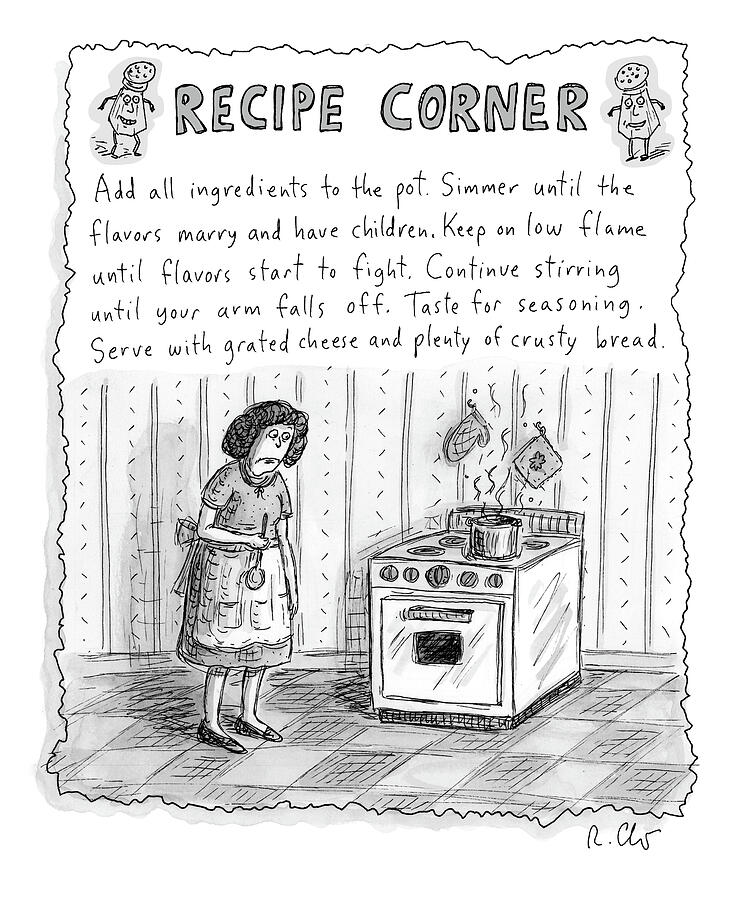
All the previous sets up a debate/discussion Carla and I have had for a long time about the nature of recipes themselves. Her take on using recipes is like jazz, meaning you know the tune and chordal progression well enough that you can improvise at any one of different points during the process. A recipe then is like a series of suggestions on how to cook something.
My take on the recipe thing is more literal—but not quite regimented. Maybe that comes from my Teutonic ancestry, which I actually don’t have, at least according to 23 and Me. They of the “sorry about the data breach and we don’t know who has all your health info.” Regardless, a couple of years ago I did the spittle test and found out that my personal serving of my parents DNA registers 98% on the Irish side and nicht on the German quotient (nada).
Genetics aside, and I’ll move them gingerly, I’ve habituated myself to taking a recipe as literal gastronomic gospel, at least the first time or two I use it. The idea being to follow the directions of the author and hopefully get something that looks like the picture at the top of the page. Which rarely happens. After all, I’m not a food stylist photographer, but a home kitchen schlepper. Besides, odds are whatever was photographed for the recipe is inedible by the time they were finished making it pretty and shiny for the magazine. After all, facial cosmetics aren’t exactly snackable either.
One of Carla’s many reasons to take recipes with a grain of salt (insert groan) is because more than a few of them are poorly written. In fact, the recipe for her favorite chicken-green chile-cheese casserole is a catastrophe of culinary writing. The casserole has long been in the rotation, but Carla rewrote the recipe so it’s easily understandable when passed on to friends.
Back to the not-so-great debate. Carla says to use recipes as guidelines and then cook like the wind! (Three Amigos). I say use recipes more literally to at least get a consistent end product. But there are caveats. If garlic is part of the equation—and it usually is—I always add an extra clove, if anything to ward off the vampires I don’t believe in. I also salt and pepper protein in small increments throughout the cooking process. By the way, I’m talking about Kosher salt here and not iodized table salt. Speaking of which, mashers (mashed potatoes) take an alarming amount of salt to taste good. Ditto that butter and other dairy. However, my usual masher recipe calls for olive oil, chicken stock, and salt and pepper. It’s tasty, but pales in comparison to the mega-caloric real thing.
Another thought about stove activity is to pay attention to the sound of something cooking, especially when using high heat. Unless the recipe calls for incinerate in 60 seconds, you can tell if the heat is too high by the sound of whatever it is in the pan sizzling. It shouldn’t sound like the scene in the movie Goldfinger, when James Bond tosses a portable heater into a bathtub full of water that also contains the bad guy who’s trying to kill him. It’s also imperative to let meat rest for 10 minutes after cooking. Otherwise, the most expensive cut of beef will taste like leather, something you pay extra for in Vegas.
In the end, I think if the contents of our mental dustbins were compared, Carla and I are closer on the great recipe debate than we think. Ultimately, if push came to shove, oven mitt came to cast iron skillet, and recipes were suddenly wiped from the face of the earth, we’d both be more than capable of dealing. But we’d also remember to add the extra clove of garlic. And to mind the vampires.
FOLLOW ME ON SOCIAL MEDIA