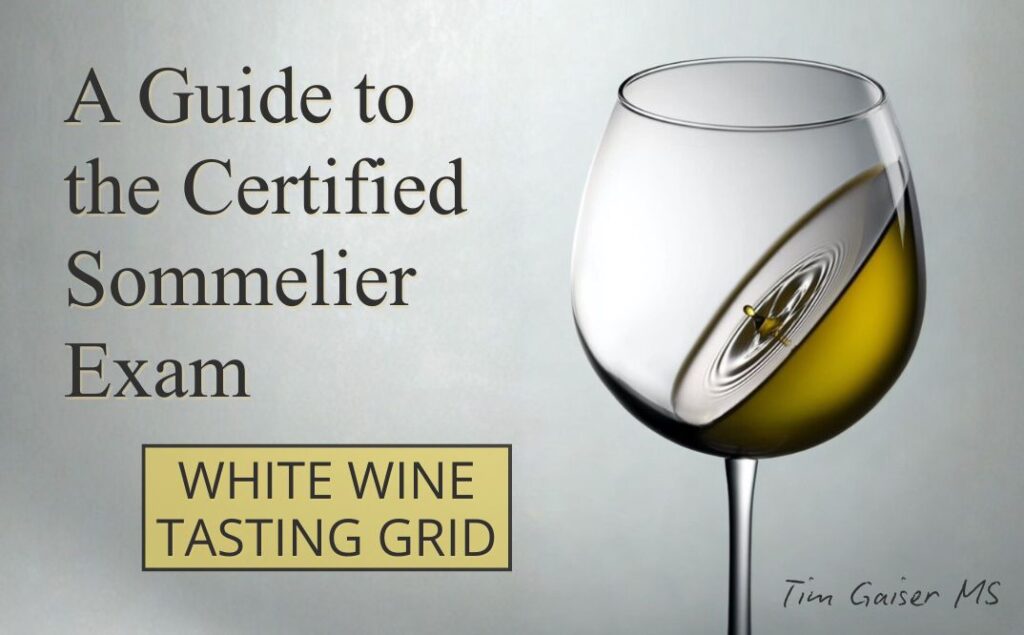
A few months ago, I facilitated a session for a group of students who will be taking the MS Certified Sommelier Exam early this year. One of the things we did during the session was taste four wines using the grid that’s part of the exam.
To begin, I tasted a white and red with the group, letting them know what the wines were. I think students initially learn more about using the grid if they know the wines being tasted. That’s because there’s so much angst about getting the grape variety that they lose focus on the rest of the process.
As we worked through the first two wines, I explained the grid in detail. Then, I had the group taste the other two wines blind, also using the grid. They did fairly well with the second pair of wines, but there were still many questions.
After the fact, I thought it would be useful to write a post that explains the Certified tasting grid in detail. With that, here is part one of two parts, explaining the white wine grid.
To begin, a couple of important thoughts about the exam:
Students are now required to use laptops or iPads for the tasting and theory parts of the exam. With the tasting, students have the option to fill out a paper grid before transferring all the answers online.
I think tasting with a written grid first is useful. It allows students to take notes if needed, and to easily erase an answer if they change their mind.
One caution, though. Students must leave enough time to transfer their answers online, or else they can run out of time and won’t get credit for their work.
Otherwise, the most important piece of advice I can give someone using the Certified grid in an exam is to be absolutely sure to fill in an answer for every line. In some cases, an aroma/flavor being asked for is not found in the wine. Then the student must still answer “no” to get credit for the correct answer.
Again, it’s imperative for the student to fill in every line. If not done, points are left on the table, so to speak.
Finally, unless asked for, only one answer is allowed per line.
Now to the white wine grid.
Color
The primary color is: Straw – Yellow – Gold
Three choices here and all have to do with the level of oxidation in the wine. This could be due to the age of the wine, if it’s been aged in oak, or was made from botrytis fruit. The general rule about color in white wine is that the older or more oxidized the wine, the deeper the color. Given that, consider the following color choices and what they could mean:
Straw: A young wine made without oak from grapes grown in a cool climate.
Yellow: A wine that’s 3-5 years old (or older), or that’s been aged in oak. The former means the fruit won’t smell/taste fresh. The latter means you’ll probably detect the spice notes from the oak.
Gold: A wine older than 5-7 years, or that spent an extended time in oak, or was made from grapes affected by the botrytis mold. If the latter is true, you’ll smell and taste botrytis markers like honey, honeysuckle, stone fruits, mushroom, saffron and more. You’ll also note them in the Non-Fruit section of the grid.
Fruit
Apple/pear: Your choice is to answer yes or no.
If yes, describe it as green apple, red apple, Bartlett pear, etc.
If you don’t smell and taste apple or pear, be sure to answer no.
Citrus: tart citrus fruit such as lemon, lime, and grapefruit. Or sweet citrus like orange and tangerine.
As before, if you find any of the previous, answer yes and describe it. Otherwise, answer no.
Stone fruit: looking for peach, apricot, and nectarine.
If present, answer yes and describe it. Otherwise, no.
Tropical fruit: such as pineapple, kiwi, mango, and papaya.
Answer yes if you find something and then describe it. Otherwise, fill in no.
Fruit condition: nose
Instructions on the grid: Select one or two fruit condition descriptors for the Nose.
Thoughts: Here you’re allowed to fill in up to two answers. Your choices for the nose are:
Tart: The fruit smells unripe and sour.
Ripe: The fruit smells ripe.
Overripe, Jammy, Candied: The fruit smells overly ripe like applesauce vs. fresh apples. If so, the wine is made from late-harvested grapes or grapes grown in a warm climate. Odds are the wine will also have higher alcohol.
Baked, dried, bruised: The fruit smells like dried apples vs. fresh apples. Both will be from an older wine that will also have a deeper color.
Fruit condition: palate
Instructions on the grid: Select one or two fruit condition descriptors for the Palate.
Thoughts: These are the same choices as the nose. You can choose up to two answers.
Tart: The fruit tastes sour and unripe.
Ripe: The fruit tastes ripe.
Overripe, Jammy, Candied: The fruit tastes overly ripe like golden apples (or apple sauce) vs. green apples.
Baked, dried, bruised: The fruit tastes like dried apples vs. green apples.
Additional thoughts: As you smell and taste through the wine, look for more than one fruit condition. More often than not, the same wine can show both tart and ripe fruit.
Also, the fruit condition may change from the nose to the palate. Be sure to note the difference.
Non-fruit
Instructions on the grid:
- Non-fruit descriptors combine NOSE and PALATE.
- Select “YES” only if it is an important character of the wine.
- Select “NO” if it is NOT an important character of the wine.
- Select ONE answer for each line.
- Do not leave any lines blank.
Thoughts: The non-fruit section is the longest of the entire grid. There’s a good reason as many of the aromas/flavors listed are important for identifying the grape variety of the wine.
As you go through the list and smell and taste the wine, mark “yes” for the things you find.
Again, it’s equally important to mark “no” for things you don’t find.
Also, remember that what you don’t find in the wine may help you identify it through the process of elimination.
Flowers: Does the wine smell and taste like flowers?
Floral notes in a white wine are important in that they may point to an aromatic grape like Gewürztraminer or Viognier.
However, some semi-aromatic grapes like Chenin Blanc and Albariño also have floral qualities.
The important thing is to mark “yes” if you smell and/or taste floral. Otherwise, the answer is no.
Fresh Herbs, Hay: Looking for herbal notes like basil, chive, oregano, and more, meaning the wine could be made from Sauvignon Blanc or Grüner Veltliner.
Green Bell Pepper, Grass, Jalapeño, Asparagus: Any of the previous are from the compound pyrazines, and point to Sauvignon Blanc as the grape.
Grape variety spice: Allspice, Pepper, Cardamon: With the presence of white pepper, Grüner Veltliner might be the grape variety. The other spices listed point to the use of oak.
Noble Rot/Botrytis: Ginger, Honey, Saffron, Wax: All are common descriptors for botrytis found in certain wines made from Chenin Blanc, Riesling, or Semillon-Sauvignon Blanc blends.
Any of the previous might also have residual sugar. However, dry wines such as Gewürztraminer and Pinot Gris can also have botrytis character.
Oxidation: Nuts, Dried Fruit: from a wine that’s over 5-7 years old or that has been aged in oak for an extended time. With the latter, you’d also find other oak markers such as toast, spice, and vanilla.
Lees: Dough, Baked Bread, Yeast, Beer, Cheese Rind: All are descriptors for white wine that’s been aged on the fine lees. Note that lees aging will give the palate a creamy texture as well.
Malolactic Fermentation: Butter, Cream, Yogurt: The buttery/buttered popcorn aromas and flavors commonly found in Chardonnay. Some Viogniers as well.
Petrol, Gasoline, Rubber: from a compound called TDN often found in Riesling.
Earth, Wet Leaves, Mushroom, Compost: If the wine shows pronounced earthy aromas and flavors, odds are it’s from an Old World or European region or country.
Mineral: Mineral, Wet Rock, Sulfur: Likewise, if the wine shows pronounced minerally aromas and flavors, it’s probably from an Old World or European place. There are always exceptions, like Clare and Eden Valley Riesling from Australia.
New Oak: Vanilla, Toast, Smoke, Cinnamon, Nutmeg, Clove: Detecting the smell and taste of new oak in white wine is important. It will help narrow down the possibilities for identifying the grape variety.
Reminder: Remember to mark “yes” only if the aroma/flavor listed is significant in the wine. Otherwise, be sure to answer “no” or you won’t get credit.
Structure
Thoughts: The structure if important for identifying the climate, place of origin, and even the grape variety. Take your time with assessing it. In fact, DO NOT RUSH THE STRUCTURE. Retaste the wine and hold it in your mouth for at least five seconds before spitting it out. Then pay close attention to the following.
Phenolic bitterness: Does the wine have a touch of bitterness on the finish that tastes and feels like almond skins? If so, the wine has phenolic bitterness from the must (juice) having been in contact with the grape skins before or during fermentation, or the wine post-fermentation. That said, your choices for phenolic bitterness are “Yes” or “No.”
Sweetness: Does the wine taste sweet from residual sugar? Certain styles of Chenin Blanc and Riesling can be off-dry to slightly sweet. Keep that in mind and connect it to the non-fruit elements, especially floral and botrytis. Otherwise, your choices for sweetness on the grid are “Dry” or “Off-Dry.”
Acidity: After retasting the wine, pay close attention to how your salivary glands respond to the acidity. The more they salivate, the higher the acidity in the wine. If the wine has higher acidity, also look for tart fruit. Your choices for acidity on the grid are as follows:
Low to Medium- / Medium / Medium+ / High
Alcohol: Smell and retaste the wine again, noting the warmth from alcohol you feel (or not) in your nose, throat, and chest cavity. The higher the alcohol in the wine, the more heat you’ll sense. Also, connect the level of alcohol to how ripe the fruit is. The riper the fruit, the higher the alcohol. Your choices for alcohol on the grid are as follows:
Low to Medium- / Medium / Medium+ / High
Conclusion
Primary Grape Variety: Select from Examinable Grape Varieties: The white wine grid will offer six choices for the grape variety. To choose a grape variety for the wine, key on the non-fruit descriptors you’ve chosen, the presence of oak, and the structural levels.
Once you’ve chosen a grape variety, you’re asked to explain why. Here, use the non-fruit descriptors and structure as keys. For example, a Chardonnay with ripe and tart fruit, lees contact, malolactic notes, and oak, with high alcohol. Or a Riesling with tart fruit, petrol notes, and mineral, with high acidity and lower alcohol.
No doubt getting the grape variety is the most challenging part of blind tasting. But if you pay close attention to all the information in the wine, you’ll be able to put together a conclusion that makes sense. It goes without saying that you’ll need to practice tasting with the grid, especially when it comes to the grape variety.
Climate: Your choices for climate are as follows:
Cool – Moderate – Warm
Again, once you choose the climate, you’ll be asked to explain why. Pay close attention to the fruit character and the structure of the wine.
For example, a wine from a cool climate will have tart fruit, higher acidity, and less alcohol. Conversely, a wine from a warm climate will have ripe/overripe fruit, less acidity, and higher alcohol.
Country of Origin: List the country where the wine was made. Theory is important here in terms of knowing where classic grape varieties are grown and the corresponding wines made. As before, you’ll be asked to explain why you chose a particular country for a certain grape.
Age range: Key on the color of the wine (the deeper the color, the older the wine) and the quality of the fruit (fresh vs dried). Your choices for age range are:
1-2 Years – 3-4 Years – 5+ Years
Sell this wine to a guest in two sentences or less
The last section of the tasting grid highlights your ability as a hospitality professional to sell the wine you’ve just described. To do so, take the most important points you’ve noted in the wine and sell them in an appealing way.
For example: “A rich, full-bodied Chardonnay that will pair well with oven-roasted chicken and root vegetables,” or “a tart Riesling that goes well with salmon with a lemon-herb butter.” Above all, remember to keep your sales pitch brief.
That’s the entire white wine grid.
A description of the red wine grid will follow in the next post.
Otherwise, in regard to the actual exam, remember to manage your time, especially if you are filling in the answers on paper before transferring them to your laptop/iPad.
Good luck!
Learn everything you need to know for the Certified Sommelier Exam.
Get the complete tasting guide.
